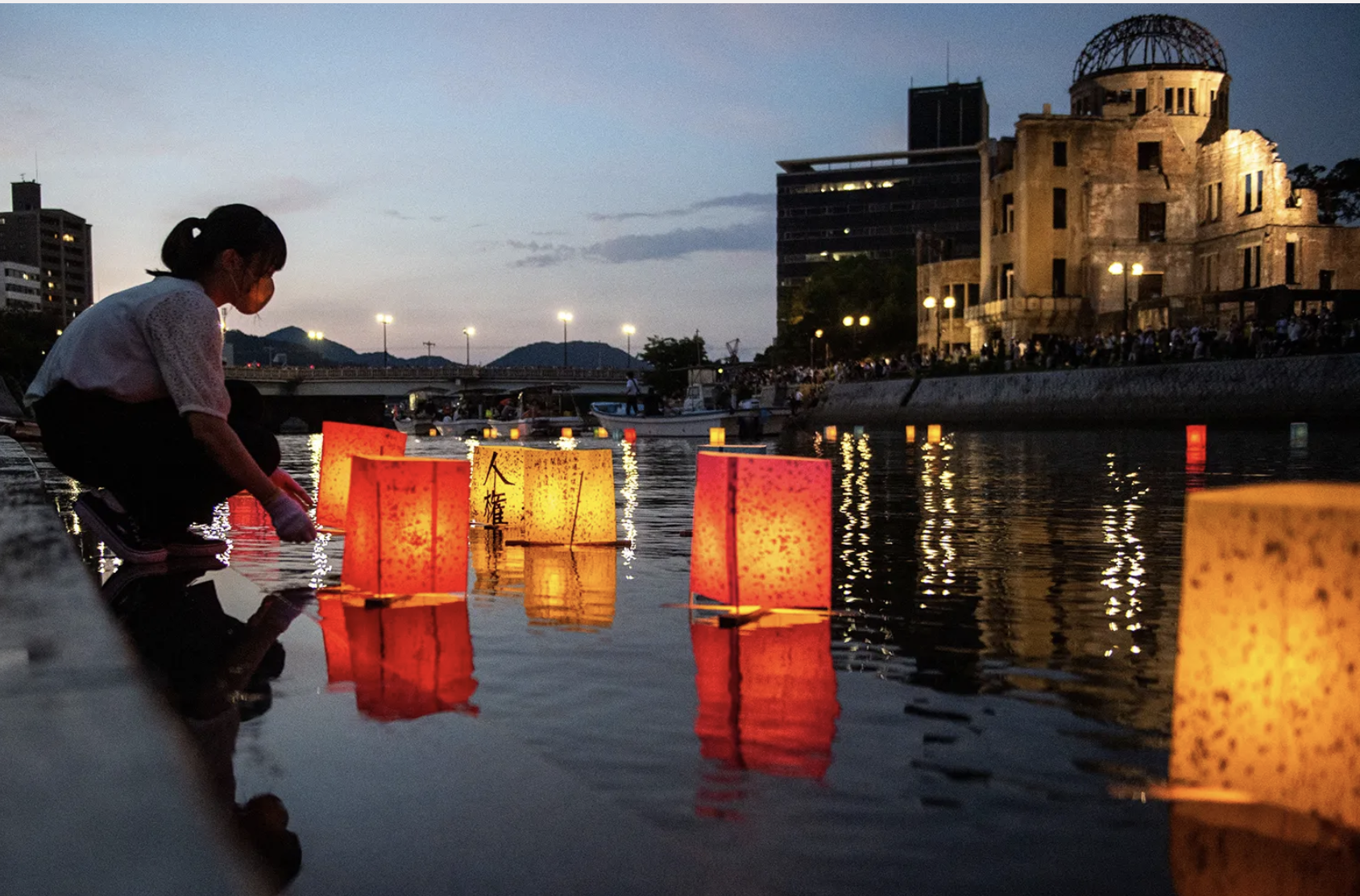
Photo by Philip Fong/AFP Getty Images
Dr. Tadatoshi Akiba: Mayors for Peace
Dear Dr. Akiba,
I hope this message finds you very well.
I’ve just returned from Japan, where I met with family and friends I haven’t seen in more than 40 years. Our reunion was joyful, tearful, immediately familiar, and bittersweet; this may be the last time we see each other. More than anything I worry about the fading stories of my family and friends, mostly of war, of hardship and fear, hope and survival, friendship, love and triumph. The destructive force of the atomic bomb extended well beyond its radius of physical annihilation. Though my mother is not hibakusha, she was a nursing student. As far away as Yokosuka, the fallout gutted lonesome caves in my mother’s spirit. It burned indelible sorrows into her eyes.
During the war rice was scarce and when there wasn’t any rice, my mother ate dried squid or fish or seaweed. When that ran out, there wasn’t much else. In nursing school the air raids began in earnest. Starving circus animals were performing on abandoned grounds, pawing the air and jumping through imaginary hoops for food that had run out while people streamed into the hospital, like the young man who pushed a wheelbarrow carrying his wife for days to find help, but his wife was already dead.
My mother’s stories resurfaced as I traveled by Shinkansen across a humble countryside jubilant with cherry blossom trees, their petals a flurry of ice pink in the wind. We swept by jade river waters muscling over smooth boulders, snowy mountain villages, tightly bundled forests, a glistening seaside, and farmers bent over seedlings in gently flooded rice paddies. Near Kakegawa we slid past eel farms at Lake Hamana and saw a lone torii gate standing bright red in the slick mud of low tide.
In Hiroshima I walked the Promenade of Peace, along the river to the famous Atomic Bomb Dome, and visited the Memorial Museum in the Hiroshima Peace Memorial Park. The weather was humid and warm, the sun was shining, stylish young people and surprisingly fit octogenarians went about their day chatting, walking, bicycling, and riding buses. Our lunch was delicious and nearby we discovered a traditional sweets shop owned by the same family for three generations that specializes in persimmon yokan, delicately powdered and cut into small thin rectangles. It was impossible to imagine everything and everyone I could see for half a mile instantly vaporized in every direction; total destruction up to a mile beyond that; severe blast damage up to two miles away; fire and charred flesh over three miles away.
At one time, an atomic bomb must have seemed impossible, just as peace now seems hopelessly elusive in Somalia, Iraq, Afghanistan, DPRK, the United States, Israel and Palestine, Syria, Sudan, the list goes on.
Inside the Memorial Museum, I read many of your letters calling for nuclear disarmament; they make up a significant percentage of the Mayors for Peace letters. They are urgent and determined; they call for goodwill and right action. What you strive for is essential to our survival, I agree, but I don’t see how such a global agreement can be reached without a new world order based on proliferation of peace. If we are to succeed, it seems we must also invest in a Department or Ministry of Peace in every country, perhaps especially in mine.
This summer I hope to attend the Hiroshima and Peace program, to lobby in Washington D.C. with Peace Alliance volunteers for a U.S. Department of Peace, and to record the stories of my family. While in Hiroshima, I would like to meet with you, if your schedule permits, to discuss ways of furthering peace and nuclear disarmament. I’m particularly interested in writing and contributing some form of stories project, possibly one that could respectfully expand the perception of atomic bomb damage beyond hibakusha and traditional spheres, beyond 1945 to the immediacy of today.
In the meantime, I invite your reply.
 Rogue Diplomacy